If you’ve ever stood in front of a cluttered workbench or loading dock, staring at mismatched power cords—one for your warehouse’s new 5HP motor and another for a portable tool that only works on a standard household plug—you’ve probably wondered this exact question. As someone who’s spent the last 12 years sourcing, testing, and selling industrial plugs and connectors, I get it. It’s tempting to grab a random adapter from the toolbox to cross those power gaps, especially when a downtime deadline is breathing down your neck. But here’s the hard truth that many installers, maintenance techs, and even small operations managers gloss over: using a regular plug adapter with an industrial plug isn’t just a bad idea—it’s a safety hazard that can ruin equipment, shut down operations, or worse, cause injury. Industrial Plug

Let me break this down with real-world examples and the kind of technical context I wish every job site manual included, because I’ve seen first-hand what happens when you cut corners here. Last year, I got a frantic call from a manufacturing plant in Ohio that had wrapped up a $2 million expansion just six weeks prior. They’d installed 12 new industrial-grade air compressors, all wired with NEMA L15-30 plugs (the 3-phase, 30-amp heavy-duty kind for continuous industrial use), and were ready to test them. But their temporary power panel on the loading dock only had standard 14-50R receptacles—those are the 50-amp ones used for big RVs, right? The maintenance tech on site grabbed an RV adapter from his truck, plugged it in, and fired up the first compressor. Ten minutes later, the adapter started smoking. By the time he cut the power, the adapter was melted, the compressor’s control board was fried, and they were looking at $12,000 in repair costs and three days of downtime. That tech wasn’t being reckless—he thought an adapter was an adapter. But industrial power isn’t the same as RV or household power, and that’s the core of the problem.
First, let’s define what each part actually is. A regular plug adapter (the kind you’d grab for a laptop or a power tool at a hotel abroad, or even a household adapter to plug a vacuum into a 240V dryer outlet) is engineered for low-voltage, low-amperage applications. Most standard household adapters are rated for 15 amps or less, 120 volts. Even the heavier RV-style adapters I mentioned earlier? They’re rated for a maximum of 50 amps, and almost all are designed for single-phase AC power. Industrial plugs, by contrast, are built for three-phase power, which is what runs most heavy machinery, motors, and process equipment. Three-phase power delivers a steady, balanced flow of electricity that handles high loads far better than single-phase, but it also has different voltage requirements (usually 208V, 480V, or even 600V for heavy industrial use) and totally different pin configurations. The NEMA L15-30 plug I referenced earlier, for example, has four pins: three for the three phases, one for ground. A standard RV adapter has only three pins—two for power, one for ground. When you force that adapter onto an industrial plug, you’re not just plugging in the right wires; you’re potentially crossing phases, overloading the adapter’s tiny internal connections, and creating a resistance that generates heat. That heat is what melted the adapter in Ohio, and it’s also what starts electrical fires.
Wait, but what if the industrial plug is a lower-amperage one? Say, a 15-amp industrial plug, and I have a 15-amp regular adapter? Still no. Even at the same amperage, industrial plugs and regular plugs don’t just share ratings—they share construction. Industrial plugs are built with much thicker, sturdier conductors. They have heavy-duty brass contacts that can handle repeated insertion and withdrawal, vibration, and exposure to dust, moisture, or oil—things that are constant in warehouses, factories, and construction sites. A regular household adapter uses thin, often tinned copper contacts that aren’t designed to take the same kind of wear. Plugging them together creates a gap between the contact points. That gap leads to arcing—little bursts of electricity that jump across the space, eroding the contacts over time. Over a few uses, that gap gets bigger, the arcing gets worse, and eventually, the connection fails. Again, that’s not just an inconvenience: arcing is a leading cause of electrical fires in industrial settings. The National Fire Protection Association (NFPA)’s 2023 report on industrial electrical hazards noted that 18% of workplace electrical fires are caused by faulty, mismatched connections—more than overloads or improper wiring. That statistic stuck with me, because it came straight from job site incidents, not just textbooks.
Another big issue is compliance. If you work in a facility that’s audited by OSHA, NFPA, or any third-party safety group, using a mismatched adapter is a violation. OSHA’s 29 CFR 1910.303(g)(1) requires that all electrical connections be of a type and rating that’s compatible with the circuit they’re connected to. They don’t care if you think it “should work”—they care about code, and mismatched adapters don’t meet code. I’ve had clients come to me after a safety audit fined them $15,000 for using just that kind of adapter. That’s more than enough to cover the cost of a proper industrial adapter or a plug conversion, not to mention the downtime and safety risks.
Now, let’s talk about what a proper adapter actually is. When we sell industrial-grade adapters, we don’t just take two mismatched plugs and crimp them together. We test every unit to UL and IEC standards, matching the amperage rating of the industrial plug to the adapter’s capacity, ensuring that the contact points are made for each other, and that the insulation is rated for the voltage of the circuit. A good industrial adapter will have locking pins or threads to keep it from slipping out under vibration, which is a must in industrial settings. It’ll also have a built-in strain relief to prevent the cord from pulling loose, which is another common failure point with regular adapters.
Wait, but what about emergency situations? I get it—sometimes a piece of equipment goes down on a weekend, and your regular electrician isn’t available. Let’s be clear: emergency doesn’t mean reckless. If you have an industrial plug that needs power right now, the only temporary solution that’s safe is a temporary industrial adapter, not a regular one. Even then, you need to test the voltage and phase of the circuit first, and make sure the adapter’s rating is equal to or higher than the industrial plug’s rating. Once the emergency is over, you have to replace that adapter with a permanent, code-compliant solution. Using a regular adapter as a long-term fix is never okay, and even as a short-term fix, it should only be done with extreme caution and only if you’re certain about the circuit specs.
I’ve spent 12 years as an industrial plug supplier, and I’ve learned that the worst mistakes come from assuming something is “close enough.” I’ve seen a construction company use a standard adapter for a 3-phase pump, only to have it fail and flood a jobsite, delaying a $50 million project. I’ve seen a food processing plant use a mismatched adapter for a mixing tank, which led to a power surge that contaminated a batch of $200,000 in product. These aren’t just stories—they’re the kind of losses that small businesses can’t absorb. The good news is that there are easy, affordable solutions to match your industrial plugs to your power sources. You don’t have to cut corners. You just have to use the right component for the job.
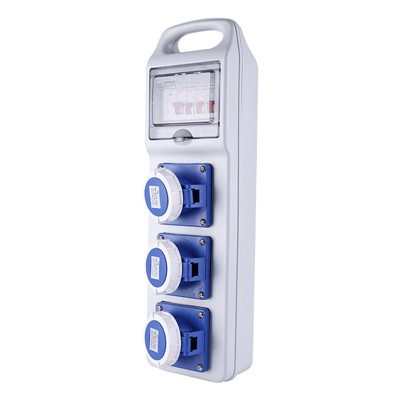
If you’re dealing with mismatched plugs, or you’re not sure what adapter is right for your equipment, I can help. I’ve worked with facilities ranging from small machine shops to Fortune 500 manufacturing plants, and I’ll take the time to walk you through your options, explain the safety differences, and make sure you get a solution that’s both compliant and reliable. Downtime doesn’t have to be inevitable, and neither do safety risks. Let’s talk about your needs—no jargon, no pressure, just real solutions for real industrial problems.
Combined Socket Box References:
National Fire Protection Association. (2023). Industrial Electrical Hazards Report. NFPA.
Occupational Safety and Health Administration. (2022). 29 CFR 1910.303(g)(1): Electrical Systems Design. OSHA.
Underwriters Laboratories. (2021). Standard for Industrial Control and Power Switching Devices, UL 60947. UL.
International Electrotechnical Commission. (2022). Low-voltage switchgear and controlgear assemblies, IEC 61439. IEC.
Zhejiang Hefeng Electric Co., Ltd.
Zhejiang Hefeng Electric Co., Ltd. is one of the most professional industrial plug manufacturers and suppliers in China, featured by quality products and low price. Please rest assured to buy durable industrial plug made in China here from our factory. Also, OEM service is available.
Address: Wenzhou Daqiao Industrail Park, Beibaixiang Town, Yueqing City, Zhejiang Province, China
E-mail: hefengplug@chinahfe.com
WebSite: https://www.hfcee.com/
