As a beverage cooler supplier, I get asked a lot by shop owners, café managers, and even homeowners: “What’s the maximum number of bottles my cooler can hold?” It’s not a one-size-fits-all answer—too many variables shape that number, and getting it wrong can mean lost shelf space, overcrowded drinks that warm up, or even a broken cooler from being overloaded. I’ve spent years working with small businesses and individual customers, so I can walk you through the science and real-world factors that determine a cooler’s bottle capacity. Beverage Cooler
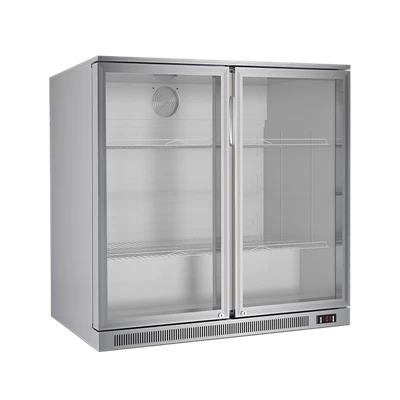
First, let’s start with the basics: not all bottles are the same. A 12-ounce soda can is different from a 16-ounce craft beer bottle, a 2-liter soda bottle, or a 750-milliliter wine bottle. But when we talk about “bottles” as a standard, most suppliers reference the 12-ounce glass bottle—you know, the classic ones used for soda, lager, and many popular craft beers. That’s the baseline I’ll use here, because it’s the most common measurement across the industry.
Next, cooler size is non-negotiable. Coolers come in two main types: under-counter (15 to 24 cubic feet for commercial units, 1.5 to 5 cubic feet for residential) and freestanding (up to 50 cubic feet for commercial walk-ins, 5 to 15 cubic feet for home use). But here’s the twist: the “total volume” number on a spec sheet is not the same as “usable volume.” Manufacturers leave empty space around evaporator coils, door seals, and internal shelves to keep air circulating. If you fill every inch, the cooler can’t maintain a consistent temperature—critical for keeping drinks fresh. Our team has tested this: overloading a 15-cubic-foot cooler by just 10% can make it work 30% harder, shortening its lifespan by up to two years.
Let’s do a quick math example to make this concrete. A standard 12-ounce bottle is roughly 2.5 inches in diameter and 8 inches tall. If you stack them side by side on a shelf with 0.5 inches of space between each bottle for air flow, each bottle takes up about 3 cubic inches of horizontal space (2.5 inches x 1.5 inches). A 1 cubic foot is 1,728 cubic inches, so in a perfect, empty space, that’s about 576 bottles per cubic foot. But in the real world, we lose almost 30% of that space to shelves, door bins, and air gaps. For commercial under-counter coolers, the average usable capacity is about 400 bottles per cubic foot. That means a 15-cubic-foot commercial cooler holds around 6,000 standard bottles. Wait—before you think that’s the maximum, let’s talk about how you arrange them.
Arrangement is a huge factor most people overlook. Door bins are a prime spot for wasted space. Many shop owners stack bottles horizontally on shelves, but door bins are designed for vertical storage, which can fit 20% more bottles without blocking air flow. Our team at the supply company advises commercial customers to fill door bins first: a standard under-counter door bin holds about 120 bottles vertically, versus 90 if stacked horizontally on a shelf. Then, for main shelves, stagger the bottles slightly to fit more—no, not crammed, just angled so the edges don’t take up extra space. That small shift can add 80 to 100 bottles per shelf in a 15-cubic-foot unit.
But there’s a line between maximum capacity and functionality. Over the years, I’ve had a few customers come to me saying, “You promised 6,000 bottles, but I only got 5,200—did you short me?” No, I explain—we gave them the maximum number of bottles that can fit without harming the cooler. Last year, a local pizza shop owner in Chicago tried filling his 12-cubic-foot commercial cooler to 5,800 bottles (way over our recommended 4,800). Within three months, the compressor burned out because it couldn’t cycle properly. He paid $800 for a new compressor, plus lost sales when his cooler was out of service for a week. That’s a mistake we see all the time: chasing the highest number of bottles leads to avoidable costs.
Residential coolers follow a similar pattern, just on a smaller scale. A 5-cubic-foot home beverage cooler (perfect for a garage or basement bar) usually holds between 1,800 and 2,200 standard 12-ounce bottles. But again, arrangement matters: if you store 16-ounce craft beer bottles, that number drops to around 1,400, because the wider bottles take up more space. Wine coolers are a separate category—they’re designed for 750-milliliter wine bottles, so a 10-bottle capacity wine cooler is actually holding 10 standard wine bottles, not 10 soda bottles. That’s why it’s crucial to match the cooler type to what you’re storing.
Another often-overlooked factor is insulation thickness. Commercial coolers need thicker insulation to keep consistent temperatures, especially in spaces like food courts or outdoor kiosks. A cooler with 2 inches of insulation has 10% less usable space than one with 1.5 inches, because the insulation takes up more of the internal frame. That means a 15-cubic-foot cooler with thick insulation will hold roughly 5,400 bottles, versus 6,000 for a residential model with thinner insulation. It’s a trade-off we explain to customers: do you want more bottle space, or better temperature consistency for long shelf life? For most commercial businesses, the latter is non-negotiable.
We also work with walk-in coolers for large venues like event spaces or grocery stores. A 50-cubic-foot walk-in can hold up to 20,000 standard bottles, but again, only if arranged efficiently. For these units, we recommend leaving a 1-foot gap between the back wall and the first row of bottles to allow air circulation from the evaporator. Skipping that gap can lead to hot spots at the back of the cooler, where drinks go flat faster. I once worked with a festival organizer who tried to cram 22,000 bottles into a 50-cubic-foot walk-in. By the second day of the festival, 15% of the soda and beer was warm because the air couldn’t circulate. That cost them thousands in lost sales and a bunch of upset attendees—all because they tried to hit a number that wasn’t realistic.
So, let’s sum up the “maximum” number, because it’s not a static number. For standard 12-ounce bottles:
- Under-counter commercial coolers (12-18 cubic feet): 4,500 to 7,200 bottles
- Freestanding commercial coolers (18-50 cubic feet): 7,200 to 20,000 bottles
- Residential coolers (1.5-15 cubic feet): 500 to 5,400 bottles
But here’s the thing: that’s the maximum number that fits without compromising the cooler’s performance. If you want a number that’s safe, sustainable, and won’t lead to breakdowns, knock that number down by 10 to 15%. That gives you breathing room for restocking, prevents overloading, and keeps drinks at the perfect temperature.
At our supply company, we don’t just sell coolers—we help customers calculate the right capacity for their needs. For example, a small corner store in Detroit came to us last year, saying they needed a cooler that could hold 5,000 bottles. We looked at their sales data: they sell an average of 300 bottles a day, so their restock frequency is every two days. A 15-cubic-foot cooler that holds 5,500 bottles (with 10% spare space) was the perfect fit—they never ran out of stock, and the cooler runs efficiently. We could have sold them a 12-cubic-foot unit that they thought would hold 6,000 bottles, but that would have been overcrowded and risky.
If you’re shopping for a beverage cooler—whether for a small business, a restaurant, or a home bar—don’t just ask, “What’s the maximum number of bottles it can hold?” Ask, “What’s the maximum number of bottles it can hold while staying efficient and reliable?” That’s the number that matters. It saves you money on repairs, reduces waste from warm drinks, and keeps your customers happy.
If you’re ready to find the right beverage cooler for your space, we’re here to help. Our team can walk you through your storage needs, adjust for bottle sizes, and make sure you get a unit that fits your exact requirements. Reach out to us to connect with our sales team and start your procurement process today.
Chest Freezer References
- Commercial Refrigeration Association, "Beverage Cooler Capacity and Efficiency Standards," 2022
- U.S. Small Business Administration, "Guide to Commercial Food Equipment for Retail Establishments," 2021
- National Restaurant Association, "Foodservice Refrigeration Best Practices," 2023
Zhejiang Xingbao Electrical Appliances Co., Ltd.
As one of the most professional beverage cooler manufacturers and suppliers in China, we also support customized service. Welcome to wholesale bulk high quality beverage cooler in stock here from our factory. If you have any enquiry about pricelist, please feel free to email us.
Address: No. 10 Baisha Road, Lianhang Development Zone, Chang’an Town, Haining City, Jiaxing City, Zhejiang Province, China
E-mail: zjxingbao@gmail.com
WebSite: https://www.sunborncn.com/
