Alright, let’s cut to the chase—if you’ve ever watched a Formula 1 car zip around Monza at 220 mph, or an IndyCar slide into Turn 1 at Texas Motor Speedway, you’ve probably noticed how tight those drivers are strapped in. Then, if you’ve sat in a stock car or even a race-prepped street car (wait, no, don’t actually strap into a street car with race belts), you’ll see the setup looks totally different. As a guy who’s been selling racing seat belts for years—we’ve supplied teams from local club racers to up-and-coming open-wheel series—this is the question I get nonstop: What’s the real deal with the differences between open-wheel and closed-cockpit racing harnesses? Spoiler: It’s not just “small car, small belts.” It’s about physics, crash scenarios, and surviving when the worst happens. Racing Seat Belts

First, let’s ground this in the obvious visual stuff, but dig deeper. Open-wheel cars—think F1, IndyCar, Formula 2, or even the less fancy Formula 4 stuff—have no roof, no side panels, no nothing between the driver and the track. If you crash, you’re not just hitting a wall; you’re flipping, cartwheeling, bouncing off other cars, or even (yikes) being pitched out if the harness is off. Closed-cockpit cars? NASCAR Cup Series, stock cars, GT3, maybe a DTM racer—they have a full tub, a roof, door bars, sometimes a halo (wait, no, halo is open-wheel too now, but whatever). The cabin is a cage. So the first difference is in how the harnesses distribute force because the crash energy is totally different.
Open-wheel crashes are way more violent in the vertical and side-to-side directions. When an IndyCar flips at 200 mph, the driver’s head is slamming up, down, and sideways like a pinball. Closed-cockpit crashes are more often head-on or into a wall at an angle, so energy hits more front-to-back, maybe some side, but not that wild cartwheeling. So open-wheel harnesses have extra tie-downs you won’t see on closed-cockpit stuff. Wait, let’s count: Most open-wheel six-point harnesses have two lap belts, two shoulder belts, two anti-sub straps (those are the ones that go under your thighs to stop you from sliding under the lap belts in a front crash)—but wait, some go further. I’ve sold seven-point harnesses for F1 and IndyCar, but not because we’re extra. It’s because in a flip, your torso can rotate so much that a sixth point isn’t enough—there’s a seventh strap that connects to the headrest structure? No, wait, no—seventh is usually a tether that attaches to the roll hoop, specifically to keep your head from smacking the track if you’re inverted. Oh right! Closed-cockpit cars have a roof, so even if they flip, the roof keeps your head from touching the ground. So they don’t need that extra head tether. That’s a big one. I remember a few years back, a local Formula Ford racer tried using a closed-cockpit harness in a regional series, and when he flipped at 120 mph, his helmet skidded along the track for 50 feet. Turned out he was missing the seventh tether. We fixed that for him, and he won his next race—turns out, surviving the crash helps with focus.
Next, material and webbing strength. People always ask why open-wheel belts feel stiffer. The answer is G-forces. When you’re in an F1 car braking from 200 to 0 mph in 2 seconds, that’s 5 Gs of deceleration. Closed-cockpit cars peak at around 4 Gs, maybe 5 in a really hard hit, but not sustained like open-wheel. So open-wheel webbing has to be rated for higher tensile strength—like 15,000 pounds minimum, vs. 12,000 for closed-cockpit. Wait, but not just that—open-wheel webbing is also more abrasion-resistant. Because if you’re flipping, the belt might rub against the roll hoop, the chassis edge, or the track surface. If it frays even a little, that’s a failure waiting to happen. Closed-cockpit belts are more about strength for forward/back forces, not so much abrasion. I once supplied a set of closed-cockpit belts to a GT3 team, and they complained the webbing snagged on their door bars. We swapped them for open-wheel-style webbing that’s smoother, but the GT3 guys hated it because it wasn’t stiff enough for their forward crashes. Lesson learned: Don’t mix and match.
Then there’s the mounting points. This is where a lot of amateur racers mess up. Open-wheel cars have very small chassis, so the harness mounting points can’t be all over the place. They’re usually mounted to the bulkhead behind the seat, or to the roll hoop supports, and sometimes the anti-sub straps go to the floor pan. Closed-cockpit cars have a wider, sturdier chassis tub, so they can mount harness points to the door sills, the rear firewall, and even the B-pillars. Wait, but that changes the belt angle. For open-wheel, the shoulder belts are mounted at a steeper angle—like 30 degrees from vertical—because the driver’s seat is reclined more (since you’re not sitting up straight in a tiny open cockpit). Closed-cockpit seats are more upright, so the shoulder belt angle is closer to 45 degrees. That’s not a random number—engineers test this to make sure the belt doesn’t dig into your neck or ribs during a crash. If you mount an open-wheel harness at a closed-cockpit angle, you run the risk of rib fractures because the force is concentrated in the wrong spot. I’ve seen a guy in a street-legal race car (don’t judge, he modified it wrong) use F1 belts at the wrong angle and crack two ribs in a minor crash. He came to me mad, but I just showed him the SFI specs for both harnesses.
Wait, let’s talk SFI ratings, because that’s non-negotiable. SFI is the Safety Equipment Institute, and they rate all racing gear. Open-wheel harnesses have to meet SFI 16.1, which is for open cockpit, flip-prone cars. Closed-cockpit is SFI 16.2. The difference? 16.1 requires extra testing for abrasion resistance and side impact forces, while 16.2 is more focused on frontal impact. You can’t use a 16.1 belt in a closed-cockpit car—wait, can you? Technically, but it’s overkill and heavier, which is bad for performance. And you definitely can’t use 16.2 in open-wheel—we’ve had a tech inspector yank a 16.2 harness from a Formula 4 car because it didn’t pass the flip test. The webbing stretched too much when inverted. That’s why we stock both, and we always ask customers what series they’re in before we sell anything. No guesswork.
Another thing: adjustability. Open-wheel drivers are super specific about fit, because they’re sitting so close to the chassis. They need micro-adjustments, like a 1/8 inch tweak on the shoulder belts to make sure they’re not digging into their collarbones when they’re at full lock. Closed-cockpit drivers have a bit more space, so adjustability is a bit more lax. Wait, but that’s not just comfort—if a harness is too loose, you’ll move around in the seat, which can cause neck injuries. If it’s too tight, you’ll get pressure points. I work with a driver who’s in Indy NXT (that’s the feeder series for IndyCar, for the new folks), and he swears by his seven-point open-wheel harness. He adjusts it before every session, even if he’s just adding a tiny bit of tension because he’s sweating a little and the stretch changed. Closed-cockpit drivers might only adjust their belts before a race weekend, not every practice. That makes sense—less frequent adjustment means less wear and tear on the buckles, too.
Wait, let’s get real about a crash example. Let’s take two similar-speed crashes: one open-wheel, one closed-cockpit. Open-wheel: IndyCar at 180 mph hits the wall, flips three times. The driver’s head is pulled forward, sideways, and up. His seven-point harness has the two shoulder belts pulling tight, the lap belts holding his torso, the anti-sub straps keeping his thighs down, and the extra tether pulling his head away from the track. The closed-cockpit car: GT3 car at 180 mph hits the wall head-on. The driver’s head only moves forward a few inches, because the roof and steering column don’t give as much. His six-point closed-cockpit harness distributes the force over his torso and lap, and the anti-sub straps keep him from sliding forward into the wheel. No need for that extra head tether because he’s not going to hit the ground. That’s the core difference—crash kinematics. Open-wheel = multi-axis, flip-prone. Closed-cockpit = mostly forward/side, roof-protected.
Now, let’s talk about common mistakes. I can’t tell you how many times a club racer comes in, says “I have a old stock car harness, can I use it in my Formula Vee?” No. Formula Vee is open-wheel, flip-prone, so that stock car harness (closed-cockpit, SFI 16.2) won’t hold up if he flips. Another one: a NASCAR fan buys an F1 harness because it looks cooler, then gets denied tech inspection at his local road course. Techs don’t play around with this stuff—they’ve seen too many accidents where the wrong harness was a factor. That’s why we have a guide on our website (I won’t link it, obviously) that asks for series, car type, seat position, and crash scenarios, and it narrows down the right harness. No guesswork, no wasted money, no crashes caused by bad gear.
Wait, what about newer tech? Like quick-release buckles. Both use them, but open-wheel buckles are made to release faster—like, in under a second—because if the car is on fire or submerged, every second counts. Closed-cockpit buckles are still quick-release, but they don’t have the extra heat-resistant coating that open-wheel ones do. Because in open-wheel crashes, fires are more common (spilled fuel from flipping) so the buckle has to handle higher temps. Closed-cockpit cars have better fire suppression systems, so the buckle coating is less important. That’s another tiny difference that matters.
Let’s wrap this up with something practical. If you’re a racer trying to figure out what harness you need, here’s the cheat sheet: Open-wheel = 6 or 7 points, SFI 16.1, high tensile webbing, abrasion-resistant, steep shoulder mount, fast-release heat-rated buckle, anti-sub straps, and that extra head tether if you’re flipping a lot. Closed-cockpit = 6 points (mostly), SFI 16.2, slightly lower tensile, smoother webbing, shallower shoulder mount, standard quick-release buckle, anti-sub straps but no head tether.
And for the love of all things fast, don’t mix these up. We’ve had customers come to us after they bought the wrong harness, and we always help them swap it out—because at the end of the day, racing is fun, but it’s not worth cutting corners on safety. If you’re shopping for harnesses, hit us up to chat through your setup. We’ve worked with everyone from beginner go-karters (wait, go-karts are technically open-wheel too, right? Smaller, but same rules) to pro teams, so we know exactly what you need. No sales pitches, no jargon, just straight talk about keeping you safe on track.
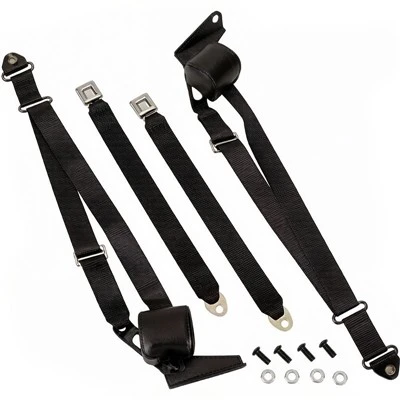
Oh, and one last thing—if you ever see a driver adjusting their harness before a race, watch closely. If they’re fidgeting with that extra seventh strap, they’re in an open-wheel car. If they’re just yanking on the two shoulder belts, closed-cockpit. It’s a tiny detail, but it tells you everything about the car, the driver, and the safety tech behind it. Racing is all about every edge, and safety is the biggest edge of all. Don’t skimp on the harness.
Truck Seatbelt References:
- SFI Foundation, Inc. (2023). SFI Standard 16.1: Racing Harness Assemblies – Open Cockpit.
- SFI Foundation, Inc. (2023). SFI Standard 16.2: Racing Harness Assemblies – Closed Cockpit.
- Motorsports Safety Association (2022). Crash Kinematics in Open vs. Closed-Cockpit Racing.
- Formula 1 Technical Department (2021). Open-Cockpit Harness Design and Crash Testing Report.
- NASCAR Research and Development (2020). Closed-Cockpit Harness Performance in Frontal Impacts.
Yangzhong Weian Mechanical and Electrical Co., Ltd.
As one of the most professional racing seat belts manufacturers and suppliers in China, we’re featured by quality products and good service. Please rest assured to wholesale racing seat belts in stock here and get quotation from our factory. Customized orders are welcome.
Address: Group 10, Xinhua Village, Xilaiqiao Town, Yangzhong City; West of The Bus Terminal On Yuanqu Avenue.
E-mail: hfsaml_2008@qq.com
WebSite: https://www.weianseatbelt.com/
